
Paver Calculator
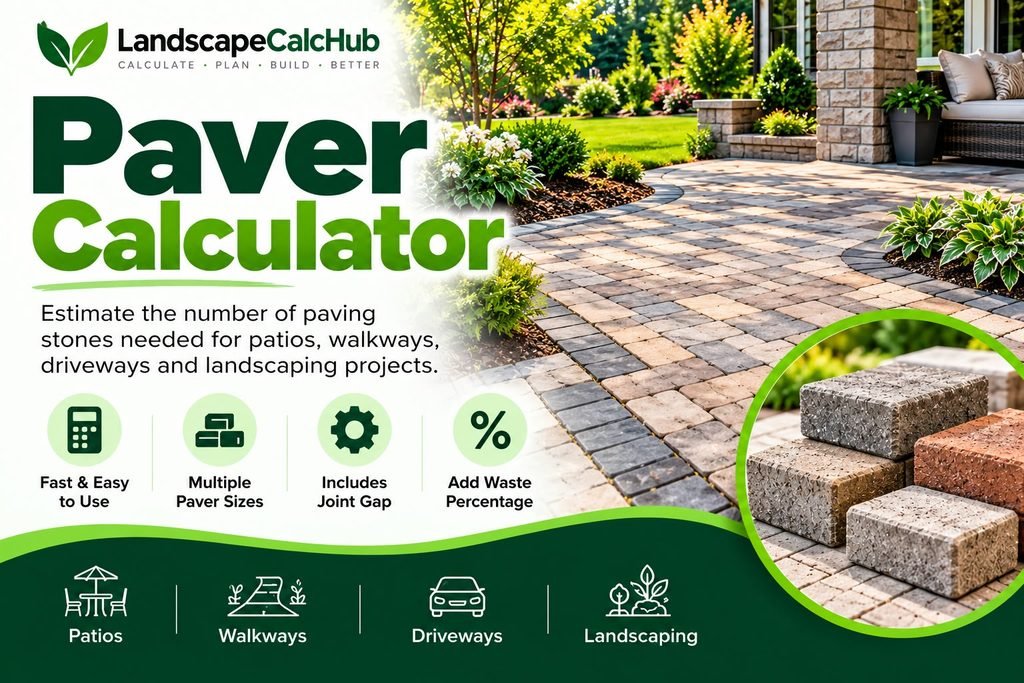
Calculate patio and walkway pavers with joint spacing and extra material for waste.
Typical narrow joint: ⅛ inch (0.125 in).
Your Paver Estimate
Estimates assume a rectangular area and uniform paver layout. Complex patterns, edge cuts, curves, and breakage may require additional material. Check the manufacturer’s installation recommendations.
How Many Pavers Do I Need? Quick Reference Table
The number of pavers you need depends on your patio size, individual paver dimensions, joint spacing, and waste allowance.
The following table provides quick estimates for common rectangular patio sizes using 12 × 12-inch pavers, no joint gaps, and a 10% waste allowance.
| Patio Size | Total Area | Pavers Before Waste | Pavers With 10% Waste |
|---|---|---|---|
| 10 × 10 ft | 100 sq ft | 100 | 110 |
| 10 × 12 ft | 120 sq ft | 120 | 132 |
| 12 × 12 ft | 144 sq ft | 144 | 159 |
| 15 × 15 ft | 225 sq ft | 225 | 248 |
| 20 × 20 ft | 400 sq ft | 400 | 440 |
Note: These estimates assume 12 × 12-inch pavers with no joint gaps. Different paver sizes, laying patterns, or joint spacing will change the quantity required.
For a more accurate estimate, enter your project dimensions, paver size, joint gap, and waste percentage into the Paver Calculator above.
How to Use Our Paver Calculator
How many pavers do I need? To estimate the number of pavers for your patio, walkway, or driveway, multiply the project length by its width to calculate the total area. Divide that area by the coverage of one paver, accounting for joint spacing, then add approximately 5%–10% for cutting and waste on simple layouts. Use our free Paver Calculator above to get an estimate based on your exact measurements.
Our free Paver Calculator helps you estimate the number of paving stones needed for patios, walkways, driveways, garden paths, and other outdoor projects. Enter your project measurements, choose your paver dimensions, and calculate the quantity you need in seconds.
Follow these simple steps:
- Select Your Measurement Unit: Choose feet and inches or meters and centimeters, depending on your project measurements.
- Enter the Area Length: Measure the length of the space where you plan to install pavers.
- Enter the Area Width: Add the width of your patio, driveway, walkway, or landscaping area.
- Choose Your Paver Size: Select a standard paver size or enter custom dimensions if your paving stones have a different size.
- Set the Joint Gap: Enter the spacing between adjacent pavers. The calculator includes this gap when estimating coverage.
- Add a Waste Percentage: Select an additional percentage to account for cutting, breakage, and installation waste. A 5% to 10% allowance is common for straightforward layouts, while complex patterns may require more.
- Click Calculate: View your total project area, estimated paver quantity, extra pavers, and final recommended quantity.
For irregularly shaped areas, divide your project into smaller rectangular sections, calculate each section separately, and combine the results.
Paver Calculator Formula
Calculating the number of pavers required for a project involves measuring the total installation area and determining how much space each paver covers.
Step 1: Calculate the Total Area
Total Area (sq ft) = Length (ft) × Width (ft)
For example, a patio measuring 20 feet long and 10 feet wide has an area of:
20 × 10 = 200 square feet
Step 2: Calculate the Effective Paver Area
When a joint gap is included, the effective coverage dimensions increase slightly.
Effective Paver Area (sq in) = (Paver Length + Joint Gap) × (Paver Width + Joint Gap)
Convert square inches into square feet:
Effective Paver Area (sq ft) = Effective Paver Area (sq in) ÷ 144
This method provides an area-based estimate for a regularly spaced paving layout.
How Many Pavers Are in One Square Foot?
The number of pavers per square foot depends on the length and width of each paving stone. Smaller pavers require more pieces to cover the same area.
For rectangular pavers measured in inches, divide 144 by the surface area of one paver to estimate the number needed per square foot.
For example, with no joint gaps:
- 4 × 8-inch pavers: 4.5 pavers per square foot.
- 6 × 6-inch pavers: 4 pavers per square foot.
- 6 × 9-inch pavers: Approximately 2.67 pavers per square foot.
- 12 × 12-inch pavers: 1 paver per square foot.
- 16 × 16-inch pavers: Approximately 0.56 pavers per square foot.
These are area-based estimates rather than exact layout counts. Joint spacing, cutting, laying patterns, and waste can affect the final quantity.
Use the Paver Calculator above to estimate the total number of pavers for your specific project dimensions.
Step 3: Calculate the Number of Pavers
Required Pavers = Total Area ÷ Effective Paver Area
Round the result up to the next whole paver.
Step 4: Include Additional Waste
Extra Pavers = Required Pavers × Waste Percentage ÷ 100
Round extra pavers up to a whole number.
Final Paver Quantity = Required Pavers + Extra Pavers
Actual material requirements may vary depending on the laying pattern, edge cuts, paver shape, and installation method.
Paver Calculation Example
Suppose you are planning a rectangular backyard patio with the following measurements:
- Patio Length: 10 feet
- Patio Width: 10 feet
- Paver Size: 6 × 6 inches
- Joint Gap: 0 inches
- Waste Allowance: 5%
Step 1: Calculate the Patio Area
10 × 10 = 100 square feet
Step 2: Calculate the Area of One Paver
6 × 6 = 36 square inches
36 ÷ 144 = 0.25 square feet
Step 3: Calculate the Required Pavers
100 ÷ 0.25 = 400 pavers
Step 4: Calculate Extra Pavers
400 × 5% = 20 extra pavers
Final Result: 420 Pavers
For this 100-square-foot patio, you should plan for approximately 420 paving stones, including a 5% waste allowance.
Frequently Asked Questions About Paver Calculations
How do I calculate how many pavers I need?
Multiply the length of your installation area by its width to find the total square footage. Then divide that area by the coverage of one paver. Add extra pavers for cuts, breakage, and waste.
How many pavers do I need for a 10×10 patio?
A 10×10-foot patio covers 100 square feet. Using 12×12-inch pavers with no joint gap, you need 100 pavers before waste. With a 10% waste allowance, the total is 110 pavers.
How many 12×12 pavers cover 100 square feet?
Each 12×12-inch paver covers one square foot when installed without gaps. Therefore, 100 pavers cover 100 square feet. Additional pavers may be required for cutting and installation waste.
How much extra should I add for paver waste?
For simple rectangular layouts, a 5% to 10% waste allowance is often suitable. Projects with curves, diagonal patterns, or numerous cuts may require 10% to 15% or more.
Does the Paver Calculator include joint gaps?
Yes. The calculator allows you to enter a joint gap between pavers. This spacing affects the estimated coverage area and the number of pavers required.
Can I calculate pavers using meters and centimeters?
Yes. Our calculator supports both imperial and metric measurements, making it useful for different project sizes and measurement preferences.
How many pavers do I need for a 20×20 patio?
A 20×20-foot patio has an area of 400 square feet. If you use 12×12-inch pavers without joint gaps, you need 400 pavers before waste. Adding 10% waste increases the total to 440 pavers.
Can I use this calculator for driveway pavers?
Yes. You can estimate the number of pavers needed for driveways, walkways, patios, and other paved areas. However, driveway projects may require thicker pavers and a properly designed base to support vehicle loads.
Does paver thickness affect the number of pavers needed?
Paver thickness generally does not change the surface quantity when the length and width remain the same. However, thickness matters for installation requirements, structural performance, and intended use.
Is this Paver Calculator free to use?
Yes. Our Paver Calculator is completely free to use. You can calculate estimated paving stone quantities for multiple landscaping and outdoor improvement projects without registration.
Preparing the foundation for your paving project? Use our Sand Calculator to estimate the sand required for paver bedding and joint filling. You can also try our Gravel Calculator to calculate the gravel needed for a stable base beneath patios, walkways, and driveways.
Planning your paver foundation? Read our Paver Base Depth Guide to understand recommended base thickness, soil preparation, drainage considerations, and how installation requirements vary for patios, walkways, and driveways
Proper installation is essential for creating durable patios, walkways, and driveways. For additional information about concrete pavers, installation practices, and pavement construction, explore the educational resources provided by the Concrete Masonry & Hardscapes Association (CMHA).