Free Soil Calculator
Estimate soil volume and weight for gardens, raised beds, landscaping, and yard projects.
Approximate bulk density. Actual weight varies with moisture and compaction.
Your Soil Estimate
Enter your project dimensions and select Calculate Soil. Estimates include your extra material allowance.
How to Use Our Soil Calculator
How Much Soil Do I Need?
To calculate how much soil you need, multiply the length and width of your garden or landscaping area to find the total square footage. Then multiply the area by the soil depth in inches and divide by 324 to calculate the required volume in cubic yards. For example, a 100-square-foot garden bed with a 6-inch soil depth requires approximately 1.85 cubic yards of soil before adding extra material. Use our free Soil Calculator above to estimate soil volume in cubic feet, cubic yards, and cubic meters, along with approximate weight based on your selected soil type.
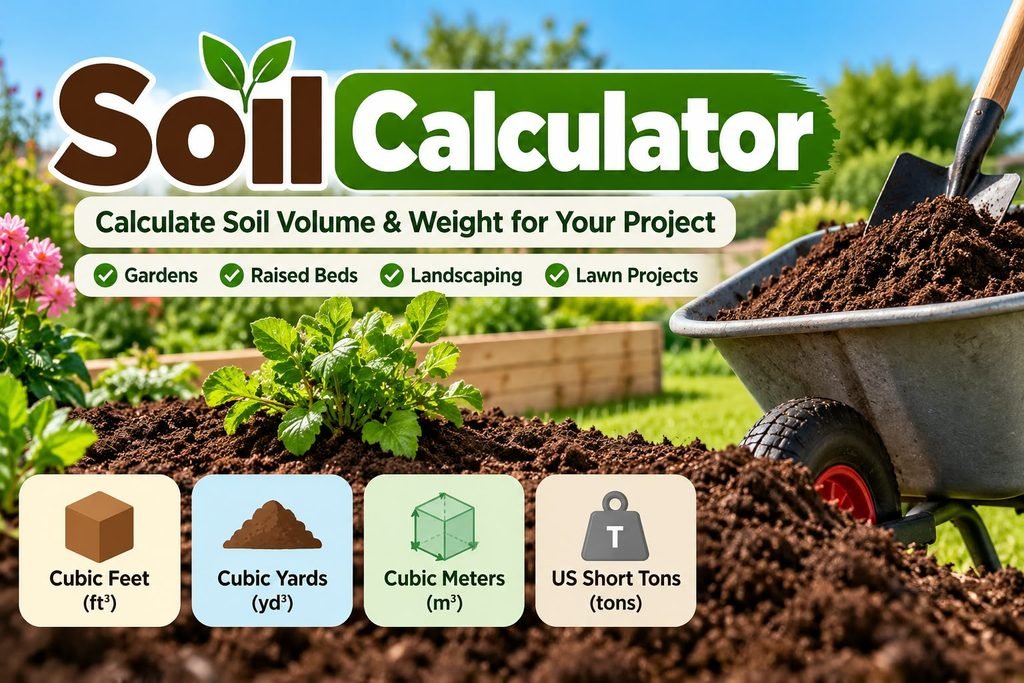
Our free Soil Calculator helps you estimate how much soil you need for gardening, landscaping, raised garden beds, lawn preparation, and other outdoor projects. Calculate soil volume in cubic feet, cubic yards, and cubic meters, along with estimated weight in US short tons.
- Select Your Measurement System: Choose Feet & Inches (US) or Metric Units.
- Enter the Length: Measure the length of the area you want to fill with soil.
- Enter the Width: Enter the width of your garden bed, lawn area, or landscaping project.
- Enter the Soil Depth: Specify how deep the soil layer needs to be.
- Choose Your Soil Type: Select the appropriate soil type to estimate its weight using an approximate density.
- Add Extra Material: Enter a percentage to allow for settling, uneven surfaces, or additional material.
- Click Calculate Soil: View your estimated soil requirements in cubic feet, cubic yards, cubic meters, and US short tons.
Soil Calculator Formula
Our free Soil Calculator uses a simple formula to estimate the amount of soil required for gardening, landscaping, raised beds, and lawn projects.
Step 1: Calculate Soil Volume in Cubic Feet
Cubic Feet = Length (ft) × Width (ft) × Depth (in) ÷ 12
Step 2: Convert Cubic Feet to Cubic Yards
Cubic Yards = Cubic Feet ÷ 27
Step 3: Convert Cubic Feet to Cubic Meters
Cubic Meters = Cubic Feet × 0.0283168
Step 4: Estimate Soil Weight
US Short Tons = Cubic Yards × Soil Density (US short tons per cubic yard)
Step 5: Include Extra Material
Total Soil Volume = Base Soil Volume × (1 + Extra Material Percentage ÷ 100)
These formulas assume a rectangular area with a uniform soil depth. Actual soil requirements may vary due to moisture, settling, compaction, and uneven ground.
Soil Volume Chart: Cubic Yards by Area and Depth
Use this soil volume chart to estimate how many cubic yards of soil you need for garden beds, raised beds, lawns, and landscaping projects. The estimates are based on the area and soil depth before adding extra material for settling or uneven ground.
| Area | 3-Inch Depth | 6-Inch Depth | 12-Inch Depth |
|---|---|---|---|
| 50 sq ft | 0.46 yd³ | 0.93 yd³ | 1.85 yd³ |
| 100 sq ft | 0.93 yd³ | 1.85 yd³ | 3.70 yd³ |
| 200 sq ft | 1.85 yd³ | 3.70 yd³ | 7.41 yd³ |
| 300 sq ft | 2.78 yd³ | 5.56 yd³ | 11.11 yd³ |
| 500 sq ft | 4.63 yd³ | 9.26 yd³ | 18.52 yd³ |
Note: These estimates exclude extra material allowances. Actual soil requirements may vary depending on settling, compaction, and site conditions.
Soil Calculation Example
Suppose you are preparing a garden bed with the following measurements:
- Length: 10 feet
- Width: 8 feet
- Soil Depth: 6 inches
- Soil Type: Topsoil
- Estimated Density: 1.10 US short tons per cubic yard
- Extra Material: 10%
Step 1: Calculate Base Soil Volume
10 × 8 × (6 ÷ 12) = 40 cubic feet
Step 2: Add 10% Extra Material
40 × 1.10 = 44 cubic feet
Step 3: Convert to Cubic Yards
44 ÷ 27 = 1.63 cubic yards
Step 4: Convert to Cubic Meters
44 × 0.0283168 = 1.25 cubic meters
Step 5: Estimate Soil Weight
(44 ÷ 27) × 1.10 = 1.79 US short tons
Final Soil Estimate
For this project, you will need approximately:
- 44.00 cubic feet
- 1.63 cubic yards
- 1.25 cubic meters
- 1.79 US short tons
These estimates include a 10% extra material allowance. Actual weight and volume may vary depending on soil composition, moisture content, and compaction.
Frequently Asked Questions About Soil
How much soil do I need for my garden?
The amount of soil you need depends on the length, width, and depth of your garden area. Enter your measurements into our free Soil Calculator to estimate the required soil volume in cubic feet, cubic yards, and cubic meters.
How many cubic feet are in one cubic yard of soil?
One cubic yard of soil contains exactly 27 cubic feet. To convert cubic feet into cubic yards, divide the total cubic feet by 27.
How much does a cubic yard of soil weigh?
The weight of a cubic yard of soil depends on the soil type, moisture content, and compaction. For example, one cubic yard of soil with an estimated density of 1.10 US short tons per cubic yard weighs approximately 2,200 pounds (1.10 US short tons). Two cubic yards of the same soil would weigh approximately 4,400 pounds (2.20 US short tons). These are illustrative estimates rather than fixed weights for all soil types. For a more accurate calculation, use the density provided by your soil supplier or select the appropriate soil type in our free Soil Calculator above.
How deep should soil be for a raised garden bed?
Many raised garden beds use approximately 6 to 12 inches of soil depth, although deeper beds may be needed for certain plants and root systems. Choose a depth based on the plants you intend to grow and the soil conditions beneath the bed.
How much soil do I need for a 10 × 10 foot area?
For a 10 × 10 foot area with a soil depth of 6 inches:
10 × 10 × (6 ÷ 12) = 50 cubic feet
50 ÷ 27 = approximately 1.85 cubic yards.
This estimate does not include additional material for settling or uneven ground.
Should I add extra soil for settling?
Yes. Some soil may settle after watering and installation. Adding an allowance, such as 5% to 10%, can be useful for certain projects. The appropriate amount depends on the soil type, project conditions, and expected settling.
Can I use this calculator for topsoil and garden soil?
Yes. Our Soil Calculator can estimate the volume required for topsoil, garden soil, and other soil materials. Select the appropriate soil type or enter a custom density to estimate its weight.
Does wet soil weigh more than dry soil?
Yes. Wet soil generally weighs more than dry soil because it contains additional water. Soil composition, moisture, and compaction all affect the actual weight.
How many bags of soil do I need?
First, calculate the total soil volume in cubic feet. Then divide that volume by the size of each soil bag. For example, if your project requires 40 cubic feet and each bag contains 2 cubic feet, you would need 20 bags before allowing for extra material.
Is this Soil Calculator free to use?
Yes. Our online Soil Calculator is free to use. You can estimate soil volume and weight for landscaping, gardening, raised beds, and lawn preparation projects without registration.
Planning your next landscaping project? Use our Sand Calculator to estimate the amount of sand needed for paving and construction projects. You can also try our Mulch Calculator to calculate mulch volume and coverage for garden beds and outdoor landscaping. Need to estimate topsoil for your garden beds, lawn, or landscaping project? Try our Topsoil Calculator to calculate the amount of topsoil required in cubic feet and cubic yards based on your project measurements.
Understanding soil health is important for successful gardening and landscaping projects. For expert information about soil quality, organic matter, and maintaining healthy soil, explore the USDA Natural Resources Conservation Service's Soil Health resources.