Topsoil Calculator
Estimate how much topsoil you need for lawns, garden beds, and landscaping projects. Calculate volume, approximate weight, bags, and material cost.
Estimated Topsoil Requirements
Volume includes your extra-material allowance. Weight uses an approximate bulk density; bag counts are rounded up. Supplier density, bag volume, and delivery costs may differ.
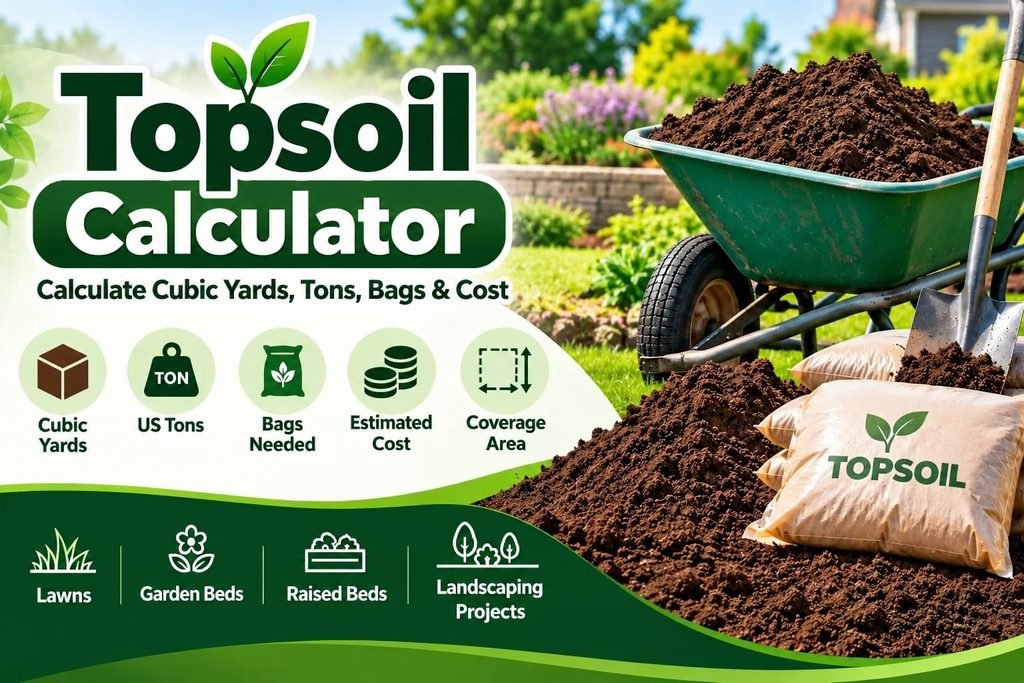
Topsoil Calculator – Calculate Cubic Yards, Tons, Bags & Cost
Planning to add fresh topsoil to your lawn, garden beds, raised beds, or landscaping project? Our free Topsoil Calculator helps you estimate exactly how much topsoil you need based on the length, width, and depth of your project.
Whether you're leveling a lawn, preparing a garden, or filling a planting area, calculating the required topsoil volume can help you avoid ordering too much or too little material.
Simply enter your measurements, select the topsoil type, choose your bag size, and add the supplier's price. The Topsoil Calculator instantly estimates the amount of topsoil you need in cubic feet, cubic yards, and cubic meters, along with approximate weight, required bags, and bulk material cost.
How to Use the Topsoil Calculator
How Much Topsoil Do I Need?
To calculate how much topsoil you need, multiply the length and width of your project area by the desired topsoil depth. For measurements in feet and inches, divide the area in square feet multiplied by the depth in inches by 324 to get cubic yards. For example, a 200-square-foot area with a 3-inch topsoil layer requires approximately 1.85 cubic yards before adding extra material. Use our free Topsoil Calculator to estimate cubic yards, weight, bags, and cost.
Follow these simple steps to estimate your topsoil requirements.
Step 1: Select Measurement Units
Choose the measurement system that matches your project.
- Feet and Inches: Enter the length and width in feet and the topsoil depth in inches.
- Meters and Centimeters: Enter the length and width in meters and the topsoil depth in centimeters.
The calculator automatically converts measurements to the appropriate volume units.
Step 2: Choose Your Topsoil Type
Select the topsoil type that best matches the material you plan to purchase.
Different soil mixtures have different bulk densities, which affect the estimated weight. If your supplier provides a specific density, use that value when a custom density option is available.
Step 3: Enter Length and Width
Measure the length and width of the area where you plan to spread topsoil.
For example:
- Length: 20 feet
- Width: 10 feet
These measurements determine the coverage area.
Step 4: Enter Topsoil Depth
Specify the desired thickness of the topsoil layer.
The appropriate depth depends on your project. A thin layer may be suitable for certain lawn topdressing applications, while new planting beds and deeper soil improvements may require significantly more material.
Step 5: Add Extra Material
Enter an additional percentage to account for uneven ground, minor measurement differences, and settling.
An allowance of approximately 5% to 10% can be useful for many projects, although actual requirements depend on site conditions.
Step 6: Select the Bag Size
Choose the volume of the topsoil bags you plan to purchase.
The calculator uses the selected bag size to estimate the number of bags required, rounding up to a whole bag.
Step 7: Enter the Price per Cubic Yard
Enter your supplier's topsoil price per cubic yard to estimate the bulk material cost.
Delivery charges, taxes, and labor costs are not included.
Step 8: Calculate Your Results
Click the Calculate Topsoil button to view:
- Coverage area in square feet
- Required topsoil in cubic feet
- Required topsoil in cubic yards
- Required topsoil in cubic meters
- Estimated weight in US tons
- Number of topsoil bags
- Estimated bulk material cost
Topsoil Calculator Formula
Topsoil calculations are based on the area being covered and the required soil depth.
- Calculate the Coverage Area
Area (sq ft) = Length (ft) × Width (ft)
- Calculate Topsoil Volume in Cubic Feet
Volume (cu ft) = Area (sq ft) × Depth (inches) ÷ 12
Dividing the depth by 12 converts inches into feet.
- Add Extra Material
Adjusted Volume = Volume × (1 + Extra Percentage ÷ 100)
- Convert Cubic Feet to Cubic Yards
Cubic Yards = Adjusted Cubic Feet ÷ 27
One cubic yard contains 27 cubic feet.
- Convert Cubic Feet to Cubic Meters
Cubic Meters = Adjusted Cubic Feet × 0.0283168
- Estimate Topsoil Weight
Weight (US Tons) = Cubic Yards × Topsoil Density (US Tons per Cubic Yard)
Topsoil weight varies with soil composition, moisture content, and compaction.
- Calculate the Number of Bags
Required Bags = Round Up (Adjusted Cubic Feet ÷ Bag Size in Cubic Feet)
- Estimate Topsoil Cost
Estimated Cost = Cubic Yards × Price per Cubic Yard
The result estimates bulk material cost and excludes delivery, labor, and taxes.
Topsoil Coverage Chart: Cubic Yards by Area and Depth
Use this topsoil coverage chart to estimate how many cubic yards of topsoil you need for lawns, garden beds, and landscaping projects. The estimates below show the required topsoil volume at different application depths before adding extra material for settling or uneven ground.
| Area | 1-Inch Depth | 2-Inch Depth | 3-Inch Depth |
|---|---|---|---|
| 100 sq ft | 0.31 yd³ | 0.62 yd³ | 0.93 yd³ |
| 200 sq ft | 0.62 yd³ | 1.23 yd³ | 1.85 yd³ |
| 300 sq ft | 0.93 yd³ | 1.85 yd³ | 2.78 yd³ |
| 500 sq ft | 1.54 yd³ | 3.09 yd³ | 4.63 yd³ |
| 1,000 sq ft | 3.09 yd³ | 6.17 yd³ | 9.26 yd³ |
Note: These estimates exclude extra material allowances. Actual topsoil requirements may vary depending on settling, compaction, and site conditions.
Topsoil Calculation Example
Let's calculate the amount of topsoil required for a rectangular lawn or garden area.
Example Project Details
| Input | Value |
|---|---|
| Topsoil Type | General Topsoil |
| Length | 20 feet |
| Width | 10 feet |
| Topsoil Depth | 3 inches |
| Extra Material | 10% |
| Assumed Soil Density | 1.20 US tons/yd³ |
| Bag Size | 2 cubic feet |
| Price per Cubic Yard | $45 |
Step 1: Calculate the Coverage Area
Area = Length × Width
20 × 10 = 200 square feet
Step 2: Calculate Topsoil Volume
Volume = Area × Depth ÷ 12
200 × 3 ÷ 12 = 50 cubic feet
Step 3: Add 10% Extra Material
Adjusted Volume = 50 × 1.10
= 55 cubic feet
Step 4: Convert to Cubic Yards
Cubic Yards = 55 ÷ 27
= 2.04 cubic yards
Step 5: Convert to Cubic Meters
Cubic Meters = 55 × 0.0283168
= 1.56 cubic meters
Step 6: Estimate Topsoil Weight
Weight = (55 ÷ 27) × 1.20
= 2.44 US tons
Step 7: Calculate Required Bags
Bags = Round Up (55 ÷ 2)
= 28 bags
Step 8: Estimate Material Cost
Cost = (55 ÷ 27) × $45
= $91.67
Final Topsoil Calculation Results
| Result | Estimated Value |
|---|---|
| Coverage Area | 200 sq ft |
| Required Cubic Feet | 55.00 cu ft |
| Required Cubic Yards | 2.04 yd³ |
| Required Cubic Meters | 1.56 m³ |
| Estimated Topsoil Weight | 2.44 US tons |
| Required Topsoil Bags | 28 bags |
| Estimated Material Cost | $91.67 |
Final Estimate: For a 20 ft × 10 ft area with a 3-inch topsoil layer and 10% extra material, you need approximately 2.04 cubic yards of topsoil, weighing an estimated 2.44 US tons.
If purchasing 2-cubic-foot bags, you would need approximately 28 bags.
At $45 per cubic yard, the estimated bulk topsoil cost is $91.67, excluding delivery and installation.
Frequently Asked Questions About Topsoil
How do I calculate how much topsoil I need?
Multiply the length by the width to calculate the area in square feet. Multiply that area by the topsoil depth in feet to find the required cubic feet. Divide by 27 to convert cubic feet into cubic yards. Our Topsoil Calculator performs these calculations automatically.
How many square feet does one cubic yard of topsoil cover?
One cubic yard covers approximately 324 square feet at a depth of 1 inch, 162 square feet at 2 inches, or 108 square feet at 3 inches. Actual coverage can vary depending on settling and ground conditions.
How much does a cubic yard of topsoil weigh?
The weight of topsoil depends on its composition and moisture content. A planning estimate of approximately 1.2 US tons per cubic yard may be used for general topsoil, but actual weight can differ substantially. Check with your supplier for a more accurate density.
How many bags of topsoil do I need?
Divide the total required cubic feet by the volume of one bag, then round up to the next whole number. For example, 55 cubic feet of topsoil requires 28 bags when each bag contains 2 cubic feet.
How deep should topsoil be for a lawn?
The appropriate topsoil depth depends on whether you're topdressing an existing lawn or preparing soil for a new lawn. Thin applications may be appropriate for topdressing, while new lawn preparation may require a deeper suitable soil layer. Follow local turfgrass guidance and assess the existing soil before adding material.
How much topsoil do I need for a raised garden bed?
Measure the length, width, and fill depth of the raised bed. Multiply these dimensions to calculate the required volume. If the bed already contains soil or other materials, subtract their occupied volume before ordering additional topsoil.
What is the difference between topsoil and garden soil?
Topsoil generally refers to the upper soil layer or a commercially supplied soil material, while garden soil is often a prepared blend intended for planting. Product composition varies between suppliers, so review the ingredients and intended use before purchasing.
Should I add extra topsoil when ordering?
An additional 5% to 10% may help account for uneven ground, settling, and small measurement differences. Larger projects or areas requiring substantial leveling may need a different allowance.
How much does topsoil cost per cubic yard?
Topsoil prices depend on location, quality, screening, soil composition, and supplier. Enter your local supplier's price per cubic yard into the calculator to estimate the bulk material cost. Delivery and installation charges may be additional.
Can I use this calculator for lawn leveling and garden beds?
Yes. The Topsoil Calculator can estimate soil volume for lawn leveling, garden beds, planting areas, and similar landscaping projects. For irregular shapes, divide the area into smaller sections, calculate each section separately, and combine the results.
Related Landscaping Calculators and Helpful Resources
Accurately estimating topsoil is an important step when preparing lawns, garden beds, and landscaping areas. If you're planning a larger project, try our Soil Calculator to estimate soil volume for different applications, or use the Compost Calculator to determine how much compost you may need for soil improvement.
For new lawn installation, our Sod Calculator can help you estimate the amount of sod required to cover your yard.
To learn more about healthy soil, soil structure, and soil management practices, explore the USDA Natural Resources Conservation Service Soil Health resources.